
How to lay out a room for watching films together
Published: September 10, 2026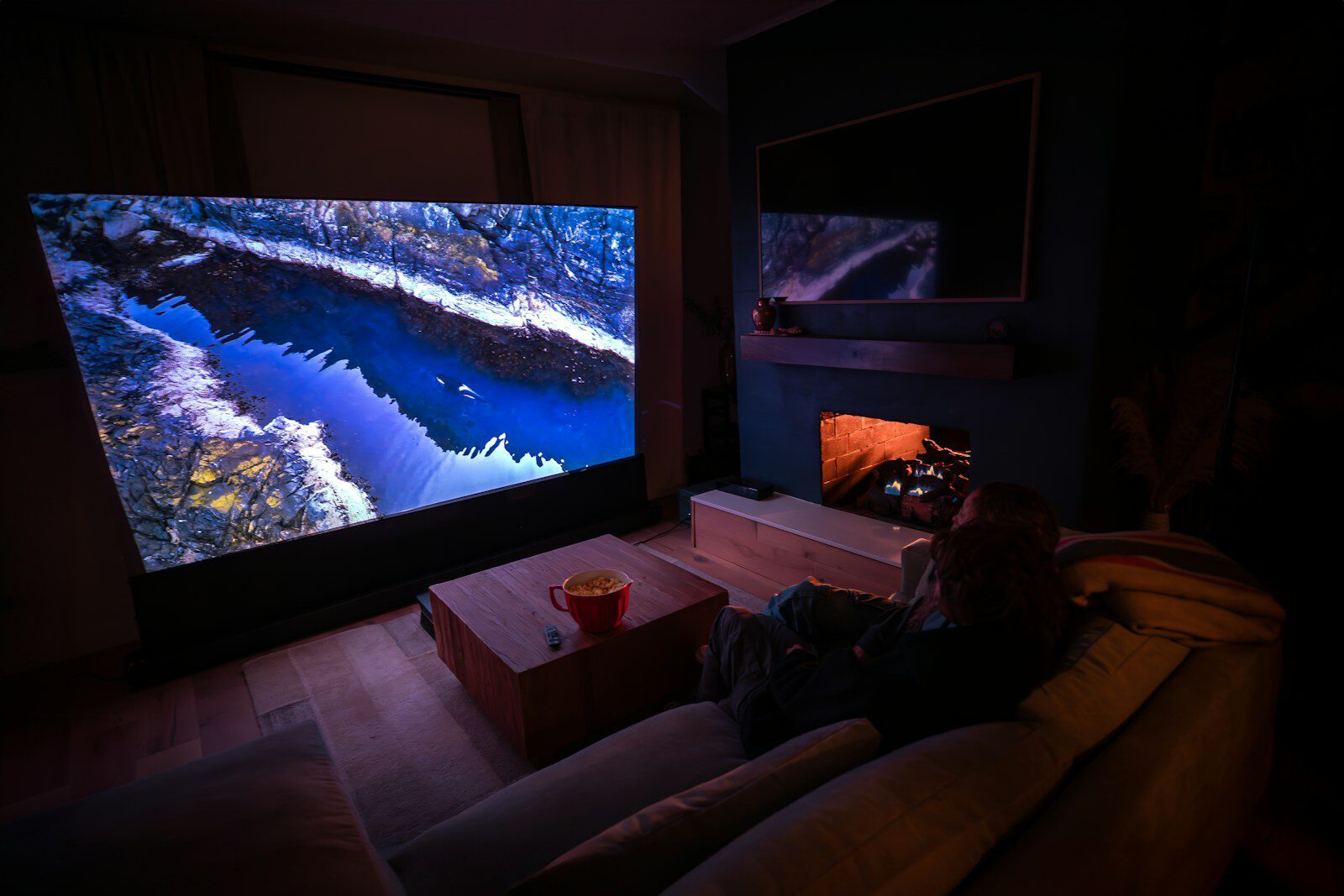
You can spend a great deal of money on a home cinema and still end up with a room where two people have a lovely time and everyone else is looking at the screen from an angle.
Seating is the part people think about last, usually after the television, the sound and the blackout blinds. It is also the part that decides whether watching something together actually feels good.
Find the best seat, then work outwards
Every room has one spot where the picture and the sound are both right. Sit in a few places with something playing and you will find it quickly. It is usually further back and more central than people expect.
That seat is your anchor. Everything else is arranged in relation to it, and the honest truth is that every other seat is a compromise against it. Knowing that is useful, because it stops you pretending the armchair in the corner is just as good.
One row is usually enough
Most front rooms are not big enough for two proper rows, and trying to force a second one gives you a back row where nobody can see and a front row where everyone is craning upwards.
If you have the depth for two, raise the back one. Even a few inches makes the difference between seeing the film and seeing the back of someone’s head. If you do not, a single row that everyone can actually see from beats a second row nobody wants to sit in.
This is where the app I built got its name. Almost every home cinema is one row, however much the magazines suggest otherwise.
Watch the viewing angle, not just the distance
People obsess over how far back to sit and then put someone at forty five degrees to the screen, which is much worse.
A rough test: sit in each seat and see whether the screen still looks like a rectangle. If it looks like a trapezium, that seat is too far to the side. On a flat panel you also lose contrast as you move off axis, so the picture goes washed out as well as skewed.
Sound comes from where the picture is
If you have centre channel speakers, the seats want to be roughly symmetrical around them. A room where three people sit left of centre and one sits right will have three people hearing dialogue coming from the wrong side.
This matters more than the speaker budget. Well placed cheap speakers beat badly placed expensive ones, every time.
Count the seats you actually need
There is a temptation to plan for the biggest night you might ever have. In practice most film nights are two or three people, and a room set up for eight feels empty and awkward with three in it.
Set the room out for your normal evening. Keep something you can drag in for the occasional crowd: a beanbag, a footstool, the dining chair that lives in the hall. Nobody minds sitting on a beanbag if it is clearly the overflow rather than their assigned seat.
One Row lets you describe the room exactly like this, named rows with however many seats each, plus the extras. The beanbag and the floor are real options, because in most houses they are real seats.
Name the seats
This sounds silly and it solves a real problem.
Once the seats have names, even daft ones, you can say who is sitting where before people arrive rather than during the shuffle when everyone walks in. “You’re on the sofa, left end” is a small courtesy that saves the room from the thing where two people hover politely and a third sits down without noticing.
It also means the person who always ends up on the floor stops always ending up on the floor, because now it is visible.
Leave a route to the kitchen
Someone will get up. They will get up during the quiet bit. If the only way out crosses in front of the screen, everybody sees it.
Plan the gap. It costs you nothing and it means the film keeps going while someone refills a glass.
Light behind the screen, not in front of it
Total darkness is hard on the eyes over a long film. A dim light behind the screen lifts the contrast of the room without washing out the picture, which is why cinemas have those low lights along the walls rather than none at all.
Anything in front of the screen, including a window and including the lamp you forgot about, is reflecting straight back at you.
Then stop fiddling and watch something
There is a point where measuring gives way to using the room. A room that is set out sensibly and gets used every Friday is worth far more than a perfect one that you are still tuning.
Seating is the part of One Row Home Cinema I rewrote the most times, because a home cinema seat plan has to cope with a sofa, a beanbag and somebody’s dad on a dining chair. The guide covers how it works, and the beta is open.
Back To Film Nights